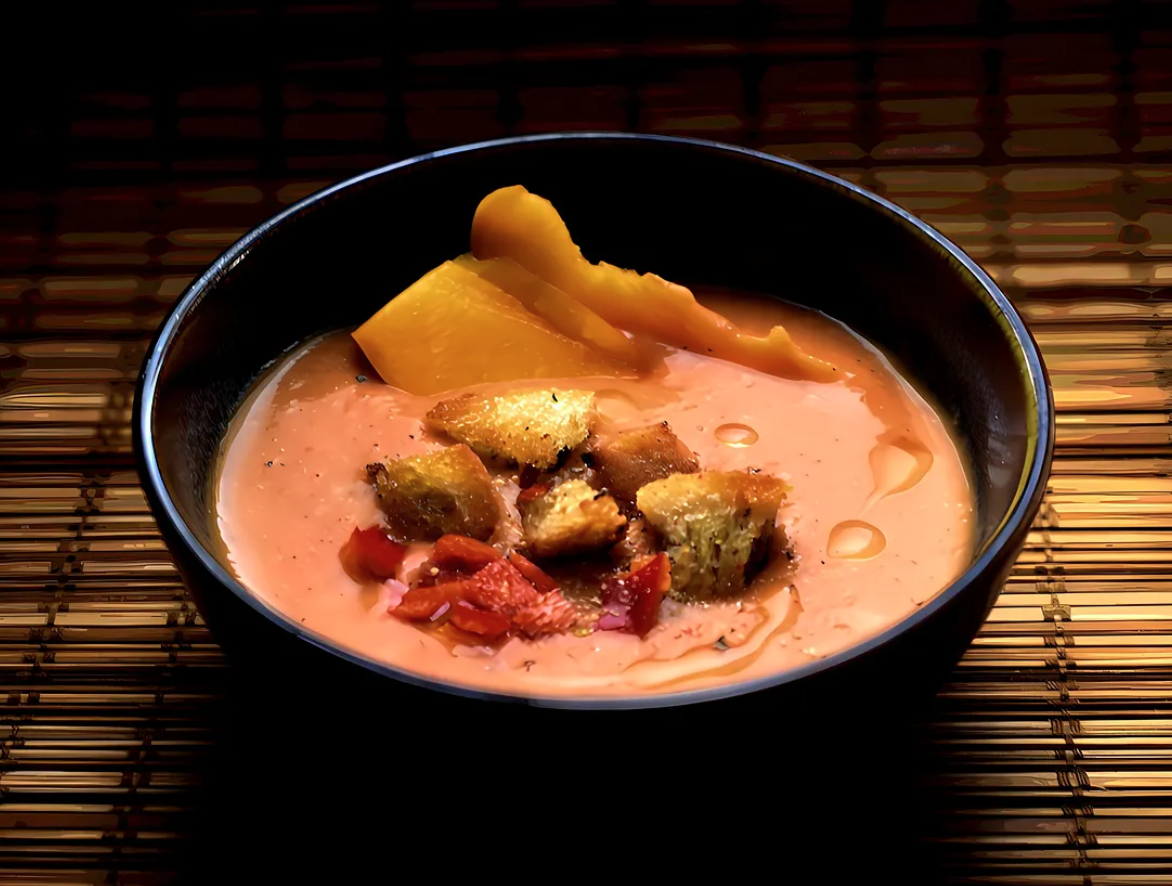
Peach gazpacho is what happens when tradition meets heatwave logic and decides to be delicious about it.
“Tradition” is a word that carries a scent. It smells like someone else’s kitchen. Like a place you don’t live anymore. Like a recipe that existed before you did passed down not just for flavour, but for comfort, identity, and a sense of continuity.
But tradition, when you zoom out, is also practical. It’s the collective memory of people trying to eat well with what they had, when they had it. Seasonality before it became a buzzword. Survival before it became a lifestyle.
Few dishes explain this better than gazpacho.
Gazpacho: A Soup Built for the Sun
Spanish summers don’t play around. In places like Seville the beating heart of Andalucía the heat can feel like it’s radiating up from the pavement. Cooking indoors, with a stove blazing, is the culinary equivalent of choosing pain.
Gazpacho is the elegant solution: a cold soup that cools you down, hydrates you, and tastes like the garden finally decided to show off.
In its most familiar modern form, Gazpacho Andaluz blends:
- fresh ripe tomatoes
- olive oil
- cucumber
- peppers
- vinegar
- onion and garlic
- and often, bread (for body and texture)
It’s simple. It’s smart. And it’s deeply tied to seasonality because the truth is, gazpacho isn’t really a “recipe” as much as it is a celebration of peak tomatoes.
Order it out of season in Spain and you’ll feel it. Not in the menu in the waiter’s face.
Tradition Isn’t Just Ingredients It’s Timing
Here’s the part people forget: tradition isn’t only about what goes into a dish. It’s also when that dish makes sense.
Tomatoes in winter are a different species. Not literally but spiritually. Pale, watery, and vaguely apologetic. Gazpacho made with winter tomatoes is like playing summer music in January: technically possible, emotionally confusing.
As one editor once put it (and it’s worth repeating): tradition is often just practical knowledge passed between generations. Not sacred rules survival tips that taste good.
And Yet… We Can Break the Rules on Purpose
Within tradition, there’s room for signature. Some people insist on peeling tomatoes. Some don’t. Some use red onion. Some use scallions. Some pour gazpacho into a bowl; others drink it from a glass like a savoury smoothie.
But the deeper truth is this:
The earliest gazpachos didn’t even have tomatoes.
Tomatoes weren’t in Europe when gazpacho first appeared centuries ago. Early versions were more like a bread-and-garlic emulsion old bread, olive oil, vinegar, salt, garlic pounded together in a wooden bowl called a dornillo.
When tomatoes and peppers arrived from the Americas in the 16th century, someone had the bright idea to throw them in. The result was modern gazpacho and Spain never looked back.
So yes. Tradition evolves. Always has.
Fruit Gazpacho: Not Traditional. Completely Logical.
Once you accept gazpacho as a flexible template cold, bright, acidic, balanced fruit additions suddenly make perfect sense. Strawberry gazpacho appears on upscale hotel menus and beachside restaurants alike. Watermelon gazpacho is practically a summer rite in certain places. Mango works. Mint works. Jalapeño works.
Traditional? No.
Delicious? Completely.
Which brings us to peach gazpacho a bowl of sweet, tangy, sunlit chaos that still feels unmistakably Spanish in spirit.
How to Make Peach Gazpacho
Peach gazpacho doesn’t taste like dessert. It tastes like summer fruit got serious, put on a linen shirt, and walked into a tapas bar.
A few practical notes before you blend:
- Peeling: If you have a high-speed blender, you can skip peeling peaches and tomatoes — the skins will disappear into the soup. If your blender is modest, peeling helps make it smoother.
- Cucumber: Persian/English cucumbers have thinner skin. If using thicker-skinned cucumbers, peel fully to avoid bitterness.
- Texture: If you want it ultra-silky, pass through a sieve. If not, embrace the rustic.
Ingredients
- 3 large ripe peaches, chopped
- 3 large ripe tomatoes (the meatier the better), cored and seeded
- ½ to 1 Persian/English cucumber, peeled and chopped
- ½ sweet onion
- 8 basil leaves
- 1 large garlic clove, smashed
- Day-old baguette, 4 slices (2 for soup, 2+ for croutons)
- 3 tbsp olive oil (plus extra for garnish)
- 2–3 tsp sherry vinegar (vinagre de Jerez) or red wine vinegar
- 1 tsp fine sea salt
- Freshly ground black pepper
Optional garnishes: sliced peaches, diced cucumber, basil, chopped jalapeño, croutons, red pepper flakes, extra olive oil.
Method
1) Start the base.
Add peaches, cucumber, and tomatoes to a blender. Pulse a few times to break everything down.
2) Build the body.
Add onion, bread, basil, and garlic. Blend on high until smooth.
3) Balance the flavour.
With the blender running, pour in vinegar. Then drizzle in olive oil slowly so it emulsifies into the soup. Season with salt and pepper. Taste. Adjust. Taste again.
4) Chill properly.
This is the secret step. Refrigerate for 2–3 hours. The cold isn’t optional it’s the point. The flavours also deepen as they rest, like they’re getting acquainted in the fridge.
Resistance is not futile. It’s flavourful.
5) Serve like summer.
Pour into bowls (or glasses), garnish how you like, and eat it slowly. This is not a soup you rush.
Why You Should Make It
Because it tastes like August. Because it requires zero stove time. Because it makes you feel like you’ve hacked the heat with elegance.
And because gazpacho — traditional or not has always been about one thing:
Taking what’s ripe, what’s real, and making it feel like relief.
¡Buen provecho!





.jpg)